
Introduction: How Long Will My Child Need Swimming Lessons?
“How long will it take my child to learn to swim?” is one of the most common questions parents ask swimming coaches. It is understandable — parents want to know what kind of progress they can expect after signing their child up for lessons.
There is no fixed number of lessons that applies to every child. Some children may begin swimming short distances independently after several months of consistent lessons, while others may need longer to become comfortable and develop the necessary skills.
The answer also depends on what you mean by “learning to swim”. Swimming a few metres without help is very different from swimming 25 or 50 metres with control, developing recognised strokes or becoming a confident swimmer with water-survival skills.
Rather than focusing only on how many lessons have been completed, it is more useful to look at the skills your child is gradually developing.
What Does “Learning to Swim” Actually Mean?
Learning to swim is not one skill that suddenly appears after a certain number of lessons. Children normally develop a combination of water confidence, body control, breathing and movement before they can swim independently.
A beginner may first learn how to enter and leave the pool safely, put their face in the water, float and kick. These basic skills create the foundation for coordinating the arms, legs and breathing needed for swimming.
Singapore’s SwimSafer 2.0 programme provides a useful example of how swimming ability develops progressively. The national programme has six stages that build swimming proficiency together with water-survival, rescue and water-safety skills.
The progression includes continuous swimming of 25 metres at Stage 2 and 50 metres at Stage 3. At the more advanced levels, swimmers progress towards 100 metres at Bronze, 200 metres at Silver and efficient swimming over 400 metres at Gold.
This is why two parents may both say that their child “can swim” even though the children are at very different levels of ability.
So, How Long Does It Usually Take a Child to Learn to Swim?
There is no official Singapore benchmark stating that every child should be able to swim independently after a particular number of weeks or lessons.
For some children, basic independent swimming may begin to develop after several months of regular lessons. This should be viewed as a possible timeframe rather than a guarantee, because children start lessons with different levels of confidence, experience and physical development.
Singapore’s SwimSafer framework also demonstrates why learning should be viewed as a progression. Each of the programme’s six stages comprises approximately 12 hours of lesson time, but that does not mean every child automatically completes a stage once those hours are finished.
Children still need to develop and demonstrate the skills required for progression.
The Ministry of Education also recognises differences in children’s starting swimming abilities. Primary schools typically offer SwimSafer during Primary 3, with most pupils beginning at Stage 1 while pupils with basic proficiency may participate at a higher level.
Instead of asking whether your child should be swimming after 10, 15 or 20 lessons, a more useful question is:
What can my child do now that they could not do when they started?
That gives parents a much clearer picture of genuine progress.
What Determines How Quickly a Child Learns to Swim?
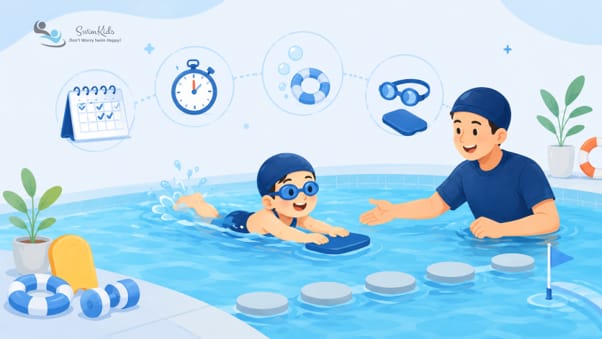
Several factors can influence the pace at which a child develops swimming skills. No single factor determines exactly how many lessons a child will need.
Water Confidence
Children begin lessons with very different levels of comfort around water.
A child who is already comfortable putting their face underwater, floating or moving around the pool may be ready to focus on swimming movements sooner. Another child may first need time to become comfortable with submerging, floating, and letting go of the poolside.
That time is not wasted. Developing confidence and control in the water is an important part of learning to swim.
Age and Physical Development
Age can influence how a child responds to swimming instruction, but it does not provide a reliable way to predict exactly how fast they will learn.
Younger children may still be developing the coordination and concentration needed to combine several swimming movements. Older children may sometimes find it easier to understand more detailed instructions, although every child’s development is different.
A child’s individual readiness matters more than comparing them with others of the same age.
How Regularly They Attend Lessons
Regular attendance gives children repeated opportunities to practise and reinforce their swimming skills.
When lessons take place consistently, children can continue working on familiar movements such as floating, breathing, kicking and stroke coordination. After a long break, some children may need time to become familiar with those skills again.
This does not mean attending twice as many lessons will automatically lead to twice the progress. Quality instruction, practice, and the child’s readiness still matter.
Previous Experience in the Water
Two children attending their first formal swimming lesson can have very different starting points.
One child may regularly spend time in swimming pools and already feel comfortable floating or putting their face underwater. Another may have had very little previous experience in the water.
It is reasonable for the second child to spend more time building foundational skills before progressing to independent swimming.
Individual Learning Pace
Children do not develop every swimming skill at the same speed.
One child may quickly develop a strong kick but need more time with breathing. Another may float easily but find coordinating the arms and legs more challenging.
Progress should therefore be measured against the child’s own previous ability rather than against another swimmer in the class.
What Does Progress Look Like During Swimming Lessons?
Parents sometimes expect every lesson to result in their child swimming noticeably further. In practice, progress does not always happen at the same pace from lesson to lesson.
Swimming development involves several smaller milestones.
Building Water Confidence and Control
For beginners, early lessons often focus on becoming comfortable and controlled in the water.
This may include safe entry and exit, putting the face underwater, blowing bubbles, floating, kicking, and recovering to a stable position.
A child may not yet be swimming across the pool, but these skills are helping prepare them for independent movement.
Beginning to Move Independently
As children become more comfortable, they can start combining individual swimming skills.
Kicking, arm movements, breathing, and body position gradually work together. At first, the child might only swim a short distance before needing to stop.
That short distance still represents an important milestone because the child is beginning to move through the water without physical assistance.
Developing Distance and Better Technique
Once independent swimming becomes more comfortable, lessons can gradually focus on improving technique and increasing distance.
Children may work on breathing more efficiently, maintaining a better body position and developing recognised strokes. Over time, distances such as 25 metres and 50 metres can become useful measures of progress.
The goal eventually becomes more than simply reaching the other side of the pool. Good swimming involves control, technique, confidence and the ability to maintain those skills over longer distances.
Can Parents Help Their Child Make Better Progress?
Parents can play an important role in supporting swimming development, although there is no shortcut that replaces appropriate instruction and practice.
One of the simplest ways to help is to maintain consistent attendance wherever possible. Regular lessons provide ongoing opportunities for children to practise skills they have already started developing.
Outside formal lessons, appropriate and supervised time in the water can help children become more familiar with the aquatic environment. This does not need to become another coaching session — enjoying the water can itself help build comfort and confidence.
Parents can also focus on specific improvements rather than comparing their child with other swimmers. Recognising achievements such as putting the face underwater independently, floating for longer or swimming a little further can help keep the experience positive.
Putting pressure on a child to meet a fixed timeline may be unhelpful. A better approach is to recognise steady development and allow skills to improve at an appropriate pace.
What If My Child Is Taking Longer Than Expected?
Taking longer than another swimmer does not automatically mean that a child is making poor progress.
Look for smaller improvements. Your child may be more comfortable underwater, require less help when floating, control their breathing better or swim further than they could a few weeks earlier.
If progress appears limited over an extended period, speak with the swimming coach. The coach should be able to explain which skills the child is currently working on and what a realistic next milestone may be.
This gives parents much more useful information than simply counting how many lessons have already been completed.
Swimming Ability Is More Than Reaching the Other Side of the Pool
Swimming independently across a pool is a major achievement, but it should not necessarily mark the end of a child’s swimming development.
Singapore’s SwimSafer 2.0 programme develops swimming proficiency alongside survival, rescue and water-safety skills. As children progress, they are expected to demonstrate increasingly demanding swimming abilities.
It is also important to remember that being able to swim does not remove the need for adult supervision around water. Children who already know how to swim can still experience water-related accidents.
The longer-term goal should therefore be to help a child become increasingly confident, capable and safety-aware in and around the water, rather than rushing to achieve one particular distance.
Conclusion: Focus on Progress, Not a Deadline
So, how long does it take for a child to learn to swim? There is no single timeframe that applies to every young swimmer.
Some children may begin developing basic independent swimming after several months of consistent lessons, while becoming confident over longer distances and developing stronger technique and water-survival skills takes further practice.
Rather than setting an artificial deadline, focus on your child’s progress in confidence, breathing, body control, technique and independence. Strong swimming foundations developed at an appropriate pace are far more valuable than simply trying to complete a certain number of lessons as quickly as possible.
Frequently Asked Questions
How Many Swimming Lessons Does a Child Usually Need?
There is no standard number of lessons that applies to every child. Progress can depend on age, previous experience, water confidence, coordination, and how regularly the child attends lessons.
Parents should focus on measurable improvements in ability rather than expecting a guaranteed result after a set number of classes.
Can a Child Learn to Swim in 10 Lessons?
Some children may make significant progress within 10 lessons and could begin swimming short distances independently. Others may still be developing foundational skills such as floating, breathing, kicking and confidence in the water.
Ten lessons should therefore be treated as part of the learning journey rather than a guaranteed deadline.
How Often Should a Child Attend Swimming Lessons?
Regular weekly lessons provide consistent opportunities to practise and reinforce swimming skills. The exact rate of progress will still vary according to the child’s ability, confidence and previous experience.
Maintaining a regular routine is generally more useful than trying to judge progress solely by the total number of lessons completed.
Does Age Affect How Long a Child Takes to Learn to Swim?
Age can influence coordination, concentration and how children respond to instruction, but it does not determine the learning timeline on its own.
Water confidence, previous experience and individual development can be just as important. Two children of the same age may therefore progress at very different rates.
Will a Child Who Is Afraid of Water Take Longer to Learn?
A child who is nervous around water may need additional time to develop confidence before concentrating on more advanced swimming movements.
That confidence-building stage is part of learning rather than a delay. Gradual, positive instruction can help the child become more comfortable before progressing to independent swimming.