
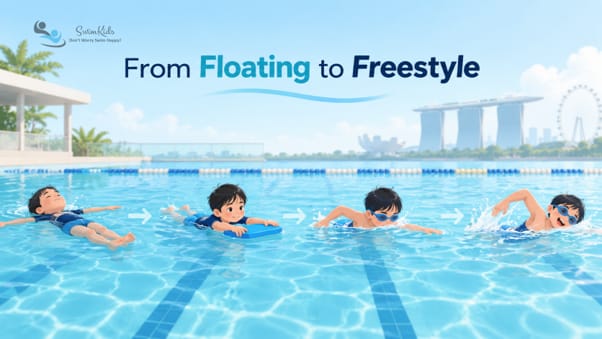
Introduction: How Children Progress From Floating to Freestyle
Watching your child learn to swim can be exciting, but it can also leave you wondering whether they are progressing quickly enough. One child may already be swimming across the pool while another of a similar age is still learning to put their face underwater or float without support.
Swimming, however, is not one skill that suddenly appears. It develops through a series of connected abilities, beginning with confidence in the water and gradually progressing towards body control, propulsion, breathing and coordinated strokes.
For parents, understanding this journey makes it easier to recognise genuine progress. A child who has just learnt to float comfortably may be making an equally important step as another child who has started swimming their first few metres of freestyle.
The First Step: Becoming Comfortable and Confident in the Water
Water Confidence Comes Before Stroke Technique
Before concentrating on arm movements or perfecting a kick, beginners first need to become familiar with being in the water. For some children, simply putting their face in the water comfortably can be an important early milestone.
Early swimming lessons therefore often include activities that may look very simple. Children might practise entering and leaving the pool safely, putting their face into the water, blowing bubbles and recovering to a standing position.
They may also learn to open their eyes underwater, move through shallow water and become familiar with how their body responds in an aquatic environment.
These activities should not simply be rushed through on the way to learning freestyle. They help establish the confidence and basic water awareness needed for more advanced skills.
Singapore’s national learn-to-swim approach similarly places confidence and independence near the beginning of a swimmer’s progression. Water-safety skills are also developed alongside swimming ability rather than being treated as a completely separate subject.
Why Confidence Matters
As children become more familiar with the water, they can gradually work on more complex movements and positions.
This does not mean that a nervous child cannot become a capable swimmer. It simply means that confidence may need to develop alongside physical swimming skills rather than being treated as something that should already be present.
Floating Teaches Children How Their Body Behaves in Water
Why Front and Back Floating Matter
Floating is often one of the first milestones parents notice, but its importance goes beyond simply staying on the surface.
When children practise floating on their front and back, they begin learning about buoyancy, balance and body position. They also develop a better understanding of how their body is supported by the water.
A front float helps prepare a child for the horizontal body position used during swimming. A back float develops another form of balance and can help the child become comfortable maintaining a supported position with the face above the water.
Singapore’s progressive swimming framework includes front and back floating among the early skills before swimmers move towards longer distances and recognised strokes.
Floating Builds Body Control
A useful float is not only about staying on the surface. Children also need to learn how to enter the position calmly and recover from it safely.
As control improves, coaches can introduce rolling, gliding and changing from one body position to another. These skills help children become more adaptable and independent in the water.
Body position, kicking, breathing and arm movement are closely connected in front crawl, so weakness in one area can affect the overall stroke. Developing body control early can therefore support later swimming skills.
From Floating to Forward Movement
Learning How to Move Through the Water
Once a child can control their body more comfortably, lessons can gradually introduce propulsion. In simple terms, propulsion means learning how the arms and legs create movement through the water.
Flutter kicking is usually an important part of early front-crawl development. Rather than focusing only on creating a large splash, children gradually learn how their kicking contributes to forward movement and body position.
At the same time, they may practise travelling on their front and back, pushing and gliding from the pool wall, reaching forwards and maintaining their direction.
Singapore’s SwimSafer progression reflects this gradual development. Earlier stages focus on fundamental movement before swimmers progress towards 25 metres of continuous swimming and later recognised strokes.
Coordination Does Not Happen All at Once
Swimming requires several parts of the body to work together, which can be challenging for a young learner. A child might be able to kick successfully while holding a float but find it more difficult when arm movements are introduced.
Another child may understand the arm action but need more time to maintain their body position while using it.
Swimming instruction therefore often develops individual components before combining them into a more complete stroke. The aim is to help the swimmer build a movement pattern they can control and repeat with increasing consistency.
Breathing Is Often the Skill That Brings Freestyle Together
Swimming Breathing Has to Be Learnt
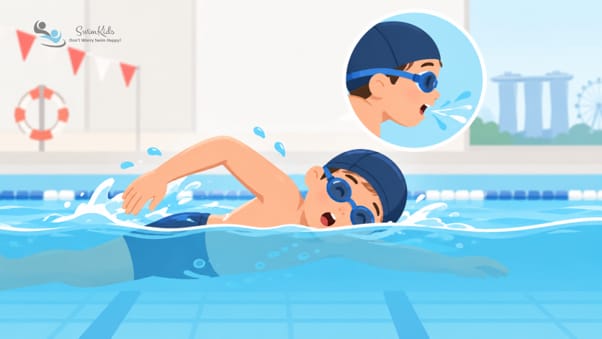
Breathing is automatic on land, but swimming changes when and how a swimmer can take a breath. This is one reason some children can move through the water before they are able to coordinate breathing comfortably.
Beginners need to develop a consistent breathing rhythm, as poor breathing technique can affect body position and the coordination of the stroke.
As confidence improves, the child learns to breathe while continuing the other parts of the stroke. Kicking, arm movement, body position and breathing gradually need to work together rather than as separate actions.
From Lifting the Head to Controlled Breathing
It is common for beginners to lift their entire head forwards when they want to breathe. This can disturb body position and interrupt the swimmer’s forward movement.
With practice, swimmers learn to coordinate breathing more smoothly with their stroke. Rather than treating the breath as a separate interruption, it gradually becomes part of the swimming rhythm.
Developing controlled breathing helps swimmers maintain their stroke over longer distances. For many young swimmers, this is one of the key differences between moving a few metres independently and maintaining a more continuous front crawl.
Putting the Pieces Together: The First Independent Freestyle
When Separate Skills Become One Stroke
There is usually an exciting point in a child’s swimming journey when the separate skills begin to connect. Their body remains reasonably horizontal, the legs continue kicking, the arms alternate and they move through the water without physical assistance.
This is what many parents recognise as their child’s first freestyle. More precisely, the stroke they are learning is front crawl, which is the stroke most commonly associated with freestyle swimming.
At this stage, the movement may not yet be fully consistent. Breathing, arm action, body position and kicking may all continue to develop as the swimmer becomes more experienced.
Early independent swimming should therefore be about building control and consistency before focusing heavily on speed.
Distance Develops Gradually
As the stroke becomes more coordinated, children can work towards maintaining it over longer distances.
Singapore’s SwimSafer 2.0 programme provides a useful example of this progressive development. One early stage includes a goal of 25 metres of continuous swimming, while a later stage progresses to a continuous 50-metre swim that includes 25 metres of front crawl and 25 metres of backstroke.
These are programme milestones rather than deadlines for individual children. They should not be interpreted as meaning every child must reach a particular distance after the same number of lessons.
Learning Freestyle Is Not the End of the Swimming Journey
From Being Able to Swim to Swimming Well
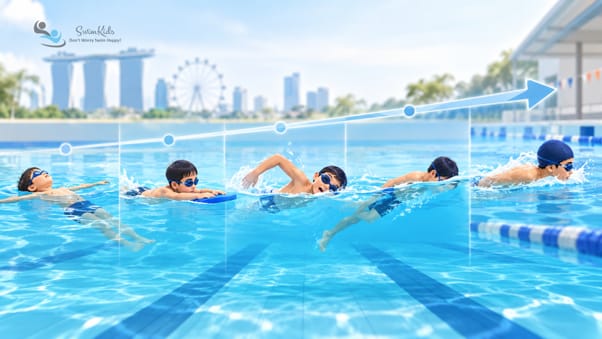
Completing a first independent length can feel like the finish line, but in reality it opens the door to another stage of learning.
A developing swimmer can continue improving how efficiently they move through the water. Breathing may become smoother, body position more stable and arm movements more controlled.
Children can also gradually build endurance so that distances which once felt challenging become easier to manage.
Singapore’s current national swimming framework reflects this idea of continued development. After fundamental swimming and safety skills, swimmers can progress towards pathways focused on longer distances, better stroke mechanics and further performance development.
Competitive swimming does not need to be the goal for every child. Becoming more confident, capable and efficient in the water is meaningful progress in itself.
Why Your Child’s Swimming Journey May Look Different From Another Child’s
Parents naturally notice what other children in a swimming class are doing. However, comparing two children only by their age or number of lessons can give a misleading picture of progress.
Children may progress differently depending on their age, competency level and prior experience in the water.
One learner may become comfortable with floating quickly but need more time to coordinate breathing. Another may require more practice before becoming confident with face submersion but then progress steadily once that foundation is established.
Singapore’s national swimming framework also recognises age- and competency-based progression rather than assuming that every learner follows exactly the same route at exactly the same pace.
Instead of asking whether another child is ahead, look at what your child can do now that they could not do previously. Becoming comfortable underwater, floating independently or completing a controlled breath can all be meaningful milestones.
How Parents Can Support the Journey Without Rushing It
Parents can make a positive difference by helping children view swimming as a skill that develops through practice rather than a test they must pass as quickly as possible.
Celebrate improvements that may appear small. For a child who was previously hesitant, putting their face in the water comfortably can be a valuable sign of progress.
Try not to introduce conflicting instructions outside lessons. If you would like to practise with your child, ask their coach which skills are suitable to reinforce.
It is also important not to confuse improving swimming ability with complete water safety. Children still require appropriate adult supervision around pools and other aquatic environments even after they become more confident swimmers.
Most importantly, avoid making speed the main measure of success. Body position, control, breathing and confidence are important foundations for developing more efficient and independent swimming.
Conclusion: Every Stroke Starts With the Foundations
The journey from floating to freestyle is made up of many connected achievements. Water confidence supports body control, floating develops balance, kicking and arm movements create propulsion, and breathing gradually brings the stroke together.
Once a child can swim freestyle independently, the journey continues through better technique, greater distance, improved endurance, and broader swimming skills.
For parents, the most useful question is therefore not simply, “How soon will my child swim freestyle?” A better question is, “What new swimming skill is my child becoming more confident and independent with?”
By recognising progress at each stage, parents can help children build a strong foundation for becoming confident, capable and increasingly independent swimmers.
Frequently Asked Questions
1. How long does it take for a child to learn freestyle?
There is no single timeframe that applies to every child. Progress can vary according to age, competency, previous experience in the water, lesson consistency and the skills the child is currently developing.
Rather than focusing on a fixed number of lessons, it is more useful to look for steady improvement in floating, movement, kicking, breathing and independent swimming.
2. Should my child learn to float before learning freestyle?
Floating is an important foundation because it helps children develop balance, body position and control in the water. Front and back floating are therefore included among the early skills in progressive swimming programmes.
A child does not necessarily need to perfect every floating skill before working on movement, but becoming comfortable in a horizontal position can support later kicking and front-crawl development.
3. Why can my child swim a few metres but struggle when breathing?
Breathing adds another movement that must be coordinated with the arms, legs and body position. Some beginners are able to move through the water before they can comfortably include regular breaths.
Developing a consistent breathing rhythm can help the swimmer maintain body position and continue the stroke for longer distances.
4. What should parents look for as signs of swimming progress?
Progress involves much more than distance. Look for improvements such as increased confidence in the water, comfortable face submersion, independent floating, better body control, more consistent kicking and improved breathing coordination.
These milestones show that a child is building the foundations required for increasingly independent swimming.
5. What comes after a child learns freestyle?
Once a child can swim front crawl independently, development can continue through better breathing, improved stroke technique, longer distances and greater endurance.
They may also continue developing other swimming strokes and water-safety skills. The focus gradually moves from completing the stroke to swimming with greater control, consistency and efficiency.